Uncovering key themes in modular construction waste management and exploring their impact and centrality

Abstract
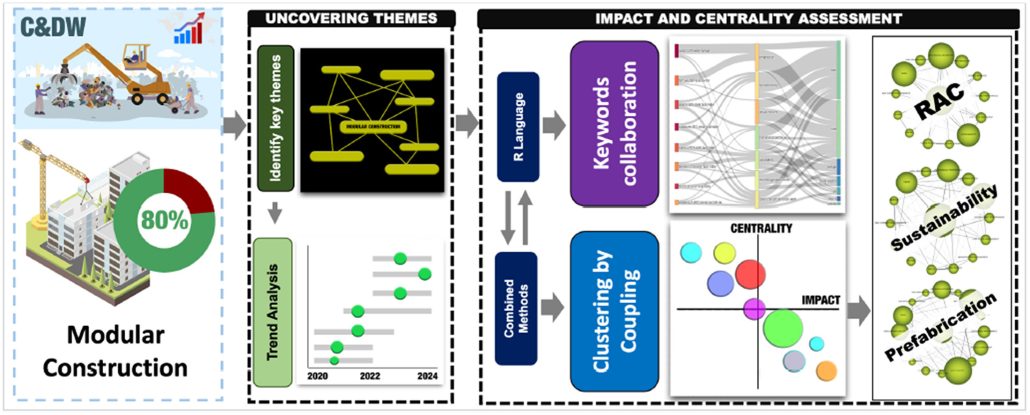
Modular construction, encompassing prefabrication and off-site construction, presents compelling benefits over conventional building techniques, notably in mitigating material waste, expediting project schedules, and reducing environmental footprint. The current study investigates 118 studies from 1,843 potential publications to identify the thematic evolution and knowledge gaps in modular construction waste management from 1996 to 2024 using combined text-mining techniques. Network mapping and node analysis using Biblioshiny and SciMat tools provide thematic development and centrality insights. Trend analysis demonstrates a significant increase in research activity post-2015, following the establishment of the United Nations Sustainable Development Goals. Co-occurrence analysis using VOSviewer identified key themes and their interrelations. Cluster analysis further delineated key themes, showing the dominance of topics such as “performance,” “mechanical properties,” and “recycled aggregate concrete (RAC)”. We found that “Reuse” and “Recycling” themes exhibit lower occurrences and link strengths. Additionally, a Sankey Diagram visualizes interrelationships between key themes, references, and contributing countries, notably highlighting contributions from China (34 %) and Spain (21 %). Further findings reveal a sustained interest in recycling from 2014, particularly recycled concrete from 2018 to 2022, underscoring the adoption of off-site construction to mitigate waste and incorporate recycled materials. Impact-centrality analysis identifies “RAC” as a high-impact theme, following “Prefabrication” and “Sustainability.” Network analysis highlights that the mechanical properties of RAC are of considerable interest and concern. The adopted text-mining approach provides a comprehensive view of thematic developments and identifies knowledge gaps, aiding researchers in addressing current waste challenges and developing evidence-based waste policies.
Graphical abstract